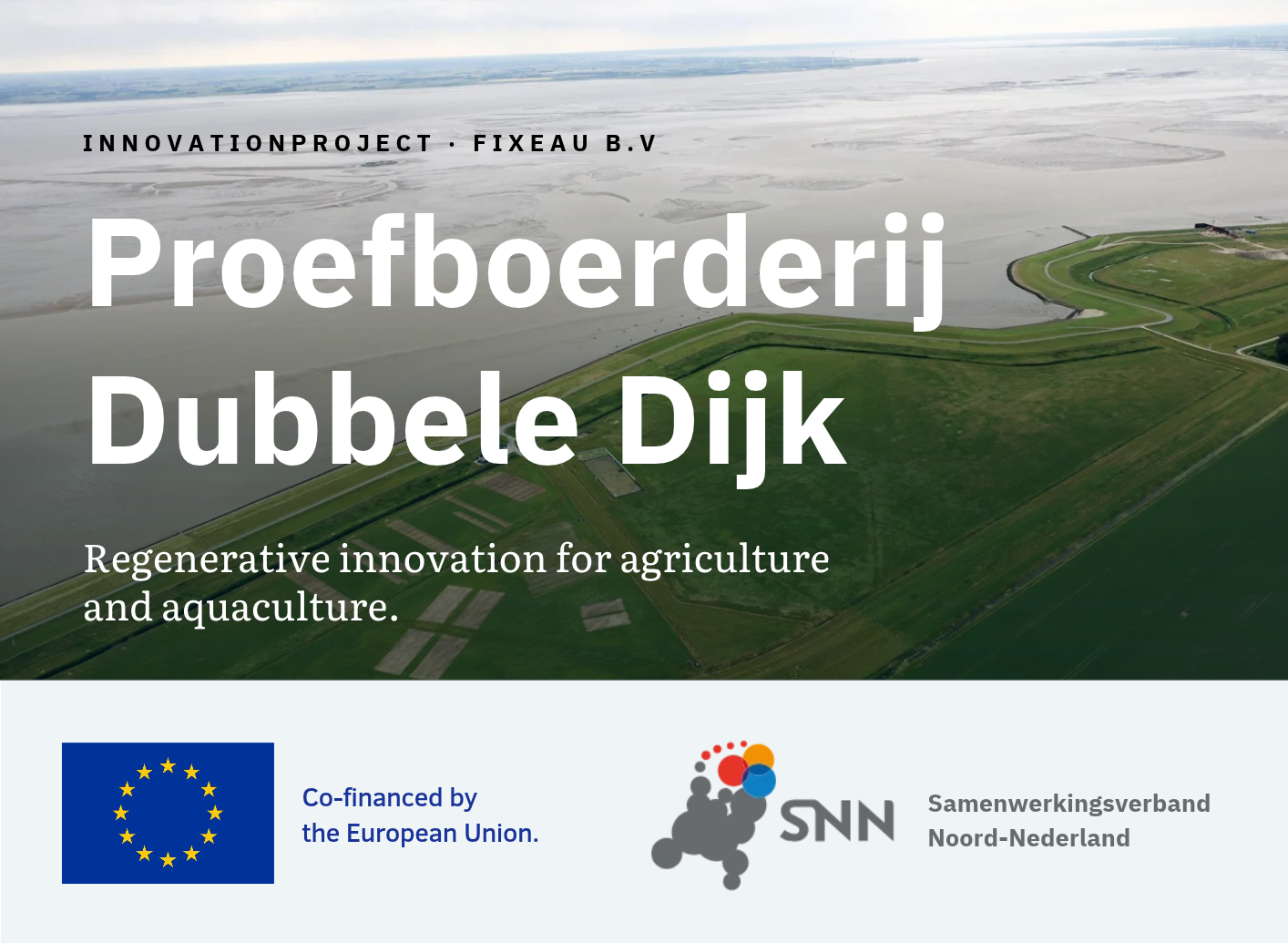
Experimental farm Dubbele Dijk: Regenerative innovation for agriculture and aquaculture
Due to land subsidence, sea-level rise, and increasing salinization, agricultural lands in Northeast Groningen are becoming less suitable - or entirely unsuitable - for high-quality crop production. The 'Dubbele Dijk' (Double Dike) experimental farm project explores and develops future prospects for sustainable and regenerative agriculture in Northeast Groningen.
ABOUT THE PROJECT
Due to land subsidence, sea-level rise, and increasing salinization, agricultural land in Northeast Groningen is becoming less suitable - or entirely unsuitable - for high-quality crop production. The 'Dubbele Dijk' (Double Dike) Experimental Farm project investigates and develops future prospects for sustainable and regenerative agriculture in the region. The Dubbele Dijk site near Bierum serves as the testing ground for this initiative.
Our role: turning water data into actionable insights
As part of the project, Fixeau is developing a hydrological advisory system for farmers and land managers. By providing insights into soil and water conditions - such as salinity levels and soil moisture - the system helps users better understand how changing conditions affect their plots. In collaboration with Hanze University of Applied Sciences, we are creating a user-friendly interface that allows farmers to translate this information into concrete decisions regarding crops, varieties, and soil management. In doing so, Fixeau contributes to an agricultural sector capable of adapting to a changing climate and increasing salinity.
The benefits:
Better insight into soil and water
Understanding hydrological soil properties and the progression of salinization under various conditions.
Smarter choices for farmers
Decision support for salinity management, cultivation strategies, and crop variety selection.
New economic opportunities
Knowledge and practical experience for profitable, climate-resilient agriculture and aquaculture within an innovative coastal zone.
This project receives funding from the Just Transition Fund (JTF) via the Northern Netherlands Partnership (SNN), co-financed by the European Union.